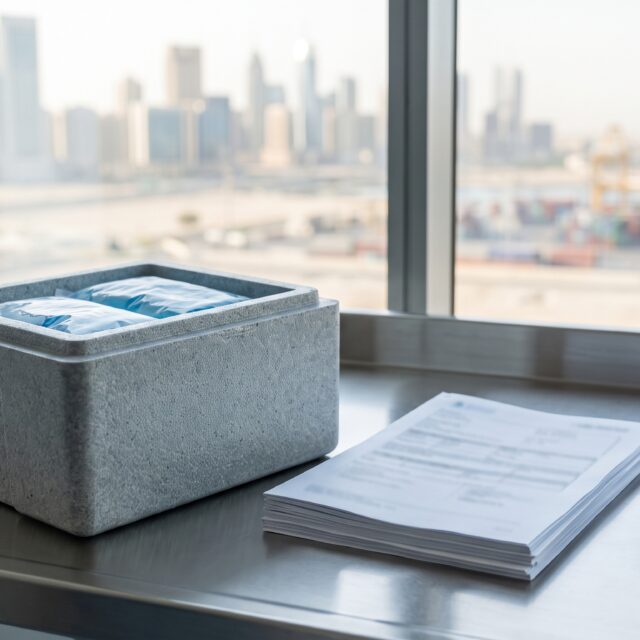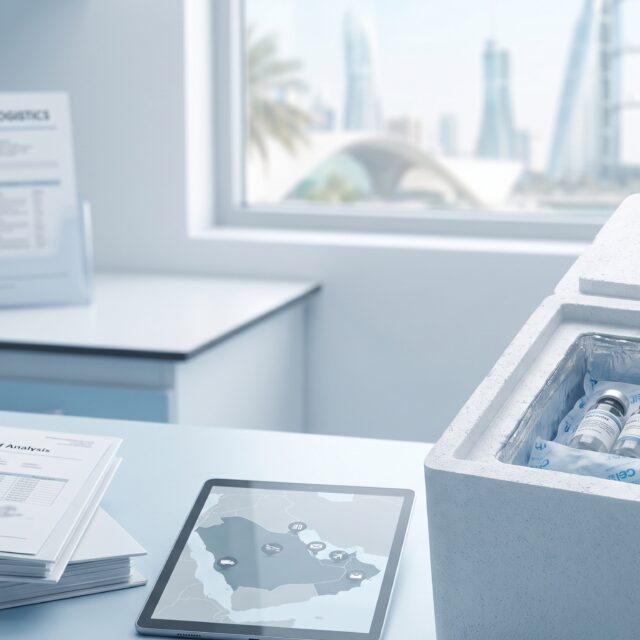

Sourcing research compounds in the UAE requires careful navigation of the updated 2026 regulatory landscape. With increased enforcement against unverified biologicals, researchers must prioritize absolute transparency. Finding reliable HPLC tested peptides Abu Dhabi is no longer just about locating a supplier; it requires verifying third-party analytical data, mitigating cross-border customs risks, and ensuring the stability of temperature-sensitive molecules.
Whether you are managing a laboratory inventory or conducting independent biological research, relying on a supplier’s unsupported purity claims is a profound operational risk. This comprehensive guide outlines exactly how to verify High-Performance Liquid Chromatography (HPLC) reports, why Mass Spectrometry (MS) is an equally critical requirement, and how to navigate the logistical hurdles of the extreme GCC summer climate.
Quick Answer: Sourcing HPLC Tested Peptides Abu Dhabi
To securely procure HPLC tested peptides Abu Dhabi, buyers must verify third-party High-Performance Liquid Chromatography (HPLC) for ≥98% purity alongside Mass Spectrometry (MS) for sequence identity. Sourcing locally from a supplier with UAE-based stock and cold-chain logistics ensures compounds bypass customs seizures and survive extreme summer heat.
Decoding the COA: Why Purity Is Only Half the Equation
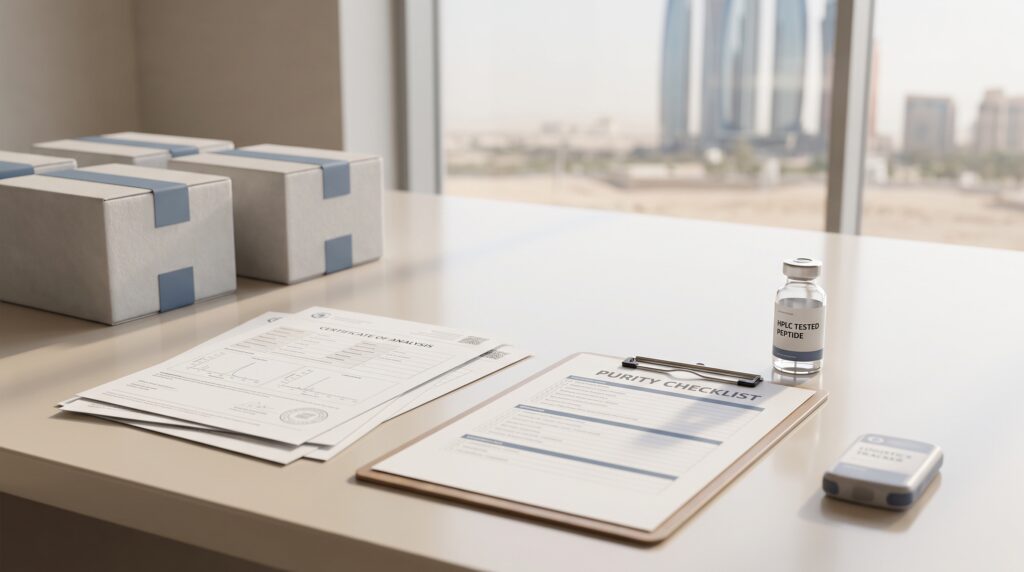
A Certificate of Analysis (COA) is the primary document used to validate the quality of a research compound. However, an incomplete or self-published COA provides a false sense of security. When evaluating any HPLC tested peptides supplier Abu Dhabi, buyers must look for two distinct analytical methods on the documentation: HPLC and MS.
High-Performance Liquid Chromatography (HPLC)
HPLC is the standard analytical technique used to measure the purity of a peptide. The process involves dissolving the sample in a solvent and pumping it through a specialized column under high pressure. Different molecules travel through the column at varying speeds based on their chemical properties, allowing the detector to separate the primary peptide from synthesis impurities, truncated sequences, or solvent residues.
For rigorous research applications, an HPLC report should demonstrate a purity of ≥98% to ≥99%. The resulting graph—known as a chromatogram—should feature one massive, sharp peak representing the primary compound, with only negligible trace peaks along the baseline.
Mass Spectrometry (MS): The Missing Link
A critical error among procurement staff is assuming a 99% purity result guarantees the correct product. HPLC only confirms that the vial contains 99% of a specific substance; it does not confirm the identity of that substance.
Mass Spectrometry (MS) is required to verify the molecular weight and amino acid sequence of the peptide. By measuring the mass-to-charge ratio of the ionized compound, MS confirms the molecular identity matches the intended research peptide. If a supplier provides an HPLC chromatogram without a corresponding MS graph, the COA is fundamentally incomplete.
Defeating Forged Reports
In today’s highly competitive market, PDF manipulation is an unfortunate reality. A legitimate test report must be independently verifiable. Look for testing conducted by recognized, third-party analytical laboratories that offer cryptographic keys or online matching portals. This allows the buyer to input a certificate number directly into the laboratory’s website to confirm the report was not altered by the vendor. You can review examples of rigorous, independently verifiable documentation on our lab results page.
The Regulatory Landscape and Local Supply
The regulatory environment in the United Arab Emirates has seen significant enforcement action regarding the importation of unverified health and research products. The Emirates Drug Establishment (EDE) and customs authorities are actively targeting unauthorized sources and unapproved biological imports.
This enforcement has direct consequences for researchers. Importing research peptides directly from international suppliers—particularly those based in overseas gray markets—now carries an exceptionally high risk of customs seizure. Packages detained at the border are often subjected to prolonged storage in non-climate-controlled customs warehouses, degrading the biological materials before they ever reach a laboratory.
Because of these tightening controls, procurement teams are abandoning international imports in favor of domestic UAE warehousing. Sourcing HPLC tested peptides in Abu Dhabi through a supplier that holds cleared, domestic stock eliminates the friction of cross-border shipping, avoids prolonged customs delays, and guarantees an unbroken chain of custody.
Beating the 45°C Heat: Lyophilized Powders vs. Liquid Pens
Beyond regulatory friction, the primary enemy of peptide stability in the GCC is the climate. During the peak summer months, ambient temperatures in Abu Dhabi routinely exceed 45°C (113°F).
Research peptides are complex chains of amino acids held together by fragile peptide bonds. When exposed to high heat and moisture, these bonds rapidly degrade through a process called hydrolysis, rendering the compound inert and ruining ongoing research.
The Vulnerability of Pre-Mixed Liquid Pens
Many international suppliers market pre-mixed liquid peptide pens for convenience. However, these are highly susceptible to thermal degradation. Once a peptide is reconstituted in a bacteriostatic or sterile liquid solution, its shelf life drops dramatically, and its vulnerability to heat spikes exponentially. Shipping a liquid peptide pen through standard postal systems in July is a near guarantee of receiving a compromised product.
The Superiority of Lyophilized Vials
To survive the UAE climate, biologicals must be shipped as lyophilized (freeze-dried) powders. Lyophilization is a complex dehydration process that removes the water matrix from the peptide while preserving its structural integrity.
Lyophilized peptides are significantly more robust and can withstand standard transport temperatures for short durations without suffering structural damage. A reputable HPLC tested peptides shop Abu Dhabi will only dispatch lyophilized vials, ensuring the researcher maintains total control over the reconstitution process using sterile bacteriostatic water in a controlled, clinical environment.
Buyer Checklist: Evaluating an Abu Dhabi Supplier
When evaluating local suppliers, researchers must assess operational reliability just as harshly as product purity. A trustworthy supplier should seamlessly meet the following criteria:
- Verifiable Third-Party Testing: Do they provide batch-specific HPLC and MS reports? Can these reports be verified independently on the testing laboratory’s official website?
- Domestic Warehousing: Are the items physically located in the UAE? Relying on a supplier who “drop-ships” from overseas reintroduces customs risks and delivery delays.
- Climate-Aware Logistics: Do they dispatch orders using temperature-controlled packaging or localized courier networks to minimize transit time in the Abu Dhabi heat?
- Lyophilized Formats Only: Do they supply strictly freeze-dried powders to maximize stability prior to reconstitution?
- Responsive Local Support: Can you reach them via local communication channels to verify stock levels, confirm batch numbers, or resolve delivery issues quickly?
- Flexible Payment Gateways: Do they offer secure local payment methods, including Cash on Delivery (COD) for buyer protection?
NOVA Labs addresses these rigorous demands by maintaining a fully transparent supply chain. We prioritize independent purity verification, stable lyophilized formulations, and domestic dispatch to ensure your research materials arrive exactly as expected, without customs friction. To view our full catalog of locally stocked, independently tested compounds, visit our shop.
The Bottom Line for UAE Researchers
Securing high-purity research compounds in 2026 requires navigating strict regulatory enforcement and extreme environmental challenges. Finding reliable HPLC tested peptides Abu Dhabi hinges on looking past marketing claims and demanding hard, verifiable analytical data. By prioritizing independent third-party HPLC and MS reporting, insisting on lyophilized powders, and utilizing domestic UAE suppliers to avoid customs seizures, researchers can confidently maintain the integrity of their work.
Take control of your procurement process by demanding transparency, verifying batch numbers, and partnering with a supplier built on operational excellence and scientific rigor.
Disclaimer: The products mentioned in this article are for research purposes only and are not intended for human consumption or therapeutic use.
*
References
- Emirates Drug Establishment (EDE) Guidelines (2026). Regulatory standards for the import and handling of biological research materials. Outlines updated customs protocols for unapproved compounds.
- NOVA Labs (2026). How To Read Peptide COA GCC: Practical Buyer’s Guide. Detailed analysis of interpreting High-Performance Liquid Chromatography (HPLC) and Mass Spectrometry (MS) documentation for research buyers.
- Journal of Peptide Science (2023). Thermal stability of lyophilized synthetic peptides. Examines the degradation rates of biologicals in liquid vs. freeze-dried states under extreme temperature exposure.
- UAE weight-loss drug crackdown: 71 sources, 14 influencers face action – Gulf News
- How To Read Peptide COA GCC: Practical Buyer’s Guide – NOVA Labs
- Nova Biolabs vs Peptides Lab UAE Abu Dhabi | 2026 Supplier
- Nova Biolabs vs peptideuae.shop: GCC Buyer Comparison (2026)
Frequently asked questions
What is the difference between HPLC and MS testing for peptides?
HPLC (High-Performance Liquid Chromatography) measures the purity percentage of a peptide by separating it from synthesis impurities. MS (Mass Spectrometry) measures the molecular weight to confirm the exact sequence and structural identity of the peptide.
Why is it difficult to import research peptides into Abu Dhabi?
Due to strict enforcement by customs and local health authorities against unverified biological imports, international shipments of research peptides frequently face high customs seizure rates and prolonged, temperature-damaging delays at the border.
Are liquid peptide pens safe to ship in the UAE summer?
No. Pre-mixed liquid peptides degrade rapidly when exposed to high temperatures. Given Abu Dhabi's extreme summer heat, lyophilized (freeze-dried) peptide powders are strongly recommended to maintain compound stability during transit.
How can I verify a peptide COA is authentic?
Authentic Certificates of Analysis should be issued by independent third-party laboratories. You can verify them by entering the unique certificate number into the testing laboratory's online verification portal to ensure the document was not altered.
What purity percentage is required for research peptides?
For precise laboratory and biological research, peptide purity should typically measure at ≥98% to ≥99%, as verified by independent High-Performance Liquid Chromatography (HPLC) analysis.
Nova Labs buyer tools
Ready to verify stock, testing and delivery?
Use the product page and lab report section to check availability, documentation, delivery timing and support before placing an order.
- COA / test-report checks
- Abu Dhabi delivery context
- Cold-chain handling
- COD and card payment options
- WhatsApp support